A kids' room changes with the child at surprising speed. The baby cot becomes redundant after a year or two, the play table is no good for homework, and the shelves fill with things no longer used. Good kids' room design plans this change in advance, as part of the interior design of the whole apartment.
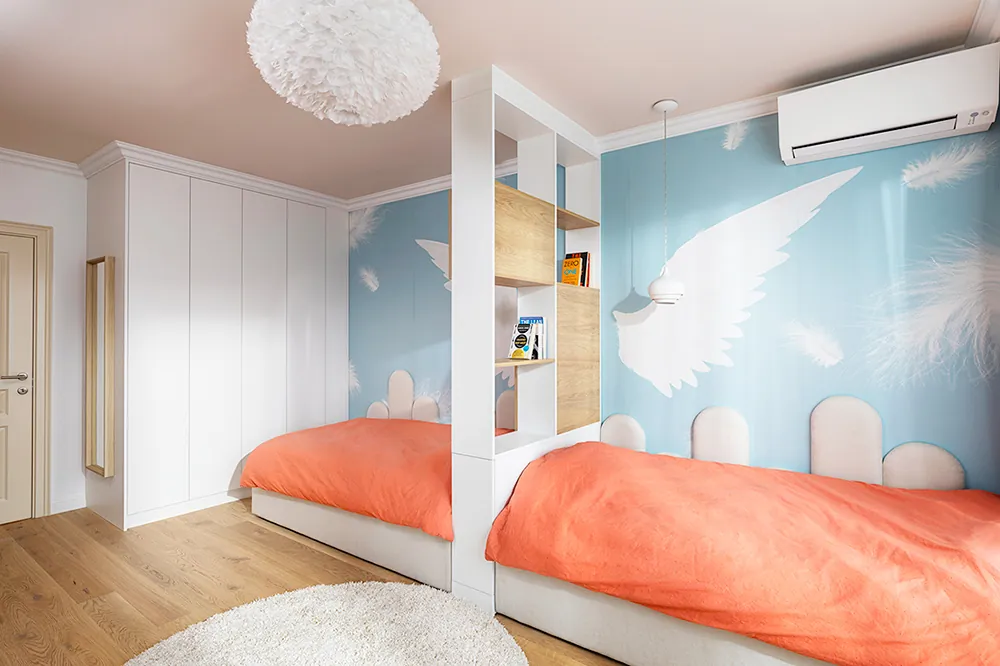
Most parents furnish the kids’ room for the moment. They buy furniture that suits the child now, and a year or two later half of it has to be replaced. In our interior design studio in Sofia the kids’ room is part of the apartment’s overall interior design and is planned for the years ahead, not just the child’s current age. An example is Neo Classic Apartment, where a shelving unit acts as a divider between two beds in one room.
This does not mean a compromise on aesthetics, quite the opposite. When the zones, furniture and materials are chosen correctly from the start, the room stays functional and pleasant while the child grows, studies and changes interests and habits.
Kids’ room ideas: why zoning is the foundation
A kids’ room has to do several different jobs at once. The child sleeps there, plays, later studies and keeps their belongings. If these functions are not clearly separated, the room quickly turns into a chaotic space where nothing is in its place.
That is why the first step in zoning a kids’ room is to decide exactly where each zone will go, before choosing furniture. Four main zones usually work.
- A sleeping zone, placed farthest from the door and from the noisy parts of the room, so it stays quiet even when the child is playing.
- A play zone, with enough free floor and low cabinets the child can reach alone.
- A study zone, which later becomes a workspace, with good natural light and a desk that can grow in height.
- A storage zone, hidden or open, that adapts over the years from toys to books and clothes.
The boundaries between zones do not have to be literal walls. A rug, a different furniture height, a shelving divider or simply the way the light is placed is often enough.
Kids’ room furniture that grows with the child
The costliest mistake when furnishing a kids’ room is buying furniture made for one age only. A car-shaped bed looks great at three, but at eight it no longer works. That is why in kids’ room interior design we look for solutions with a long life.
A bed with adjustable length is a better investment than a fixed-size child’s bed, because it lasts literally into the teenage years. A height-adjustable desk grows with the child instead of being replaced at every school stage. Open modular cabinets can be rearranged to suit needs instead of becoming redundant.
A good practice is to choose storage furniture that is neutral in form, and let individuality come from the colours of the walls, the textiles and the accessories, which can be changed easily and cheaply over time.
Materials that withstand play, spills and years
A kids’ room takes much more wear than the other rooms in the home. That is why the choice of materials is just as important as the choice of furniture.
Floor coverings must be impact-resistant and easy to clean, without losing the warm feel of the space. Laminate with a high wear class or quality vinyl works well in practice. For the walls, washable paints save repainting after every marker stain.
Textiles also play a role. Curtains, cushions and rugs made of durable fabrics cope better with frequent washing and play on the floor, while a neutral base allows the accents to be changed easily as the child grows.
How we plan the kids’ room in a home project
When the kids’ room is part of a whole-apartment project, we first discuss the family’s way of life, the number of children who will use the space and the plans for the coming years. Then comes a zoning plan, a choice of long-life furniture and a palette of materials that stays relevant over time.
COZY. Design does interior design and consultations across the country, entirely online or on site, and every home project is prepared individually for the space and the family. We work on whole homes, so the kids’ room is part of the overall project, not a separate service.
- Plan the zones before buying furniture, not the other way round.
- Choose a bed and a desk that can be adjusted, instead of fixed children’s models.
- Rely on a neutral base and changeable accents for easy updating.
- Choose floor coverings and paints that withstand intensive use.
- Leave free space for play, which can later become a study corner.
If you are planning interior design for a home where the kids’ room works well today and in five years, take a look at our services and completed projects to see how well-considered spaces look in practice.
Ready for an interior with character?
We create bold, memorable interiors for home and business, working in Sofia and online across Bulgaria.
Get in touch → ← Back to the blog